



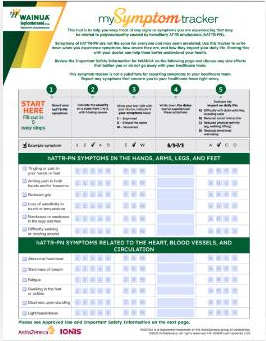
Track Your Symptoms
You can play a key role in helping your doctor determine if you have hATTR-PN. Use My Symptom Tracker to write down your symptoms, then share it with your doctor at your next appointment.
Download Symptom Tracker
Amyloidosis is a group of diseases that causes your body to produce abnormal proteins that misfold (called amyloids). These can build up in tissues and organs, leading to a range of symptoms and complications.
Hereditary ATTR (hATTR) is an inherited kind of amyloidosis caused by abnormal transthyretin proteins
(also known as TTR). TTR is made primarily in the liver and carries vitamin A and thyroid hormones. In people with hATTR, unstable TTR protein breaks apart, misfolds, and forms amyloid fibrils Amyloid fibrils A buildup of proteins that can lead to symptoms when they occur in certain parts of the body.
that can build up and cause damage throughout the body.

hATTR amyloidosis is passed down through family members (genetically inherited). If one parent has hereditary ATTR amyloidosis, there is a 50% chance their child will inherit the variant. However, not everyone who inherits the variant will go on to develop the symptoms of hATTR amyloidosis.
Globally, there are over 130 different variants in the TTR gene that can lead to hATTR; these can present in specific geographic regions and populations. Many people could be carriers, at risk of developing amyloidosis themselves and potentially passing it down to their children.
hATTR affects everyone differently. Its symptoms can often look like those of other, more common conditions. Genetic testing can help you and your doctor get to the correct diagnosis.
Many people may have hereditary ATTR amyloidosis and not know it. Symptoms may seem unrelated or may initially appear to be a different disease such as chronic inflammatory demyelinating polyneuropathy (CIDP), diabetic neuropathy, or irritable bowel syndrome (IBS).
Hereditary ATTR amyloidosis can significantly affect quality of life by causing a range of serious symptoms, a loss of independence, and an inability to participate in daily activities.
The amyloid deposits caused by hATTR damage the structure and the functions of the organs and tissues where they are found. In hATTR, amyloid deposits are most commonly found in:
The nervous system

The digestive system

The heart
WAINUA is not approved for the treatment of cardiomyopathy Cardiomyopathy is a disease of the heart muscle that makes it harder for the heart to pump blood. It can cause symptoms like shortness of breath, tiredness, swelling in the legs, ankles or feet, or feeling the heart beat in a strange way. symptoms.
Symptoms of hATTR can seem unrelated, as amyloids can deposit in various tissues and organs, and present as more common conditions, making it difficult to diagnose.

Ocular
Symptoms related to the eyes, often causing visual changes. These can include blurred or spotty vision, floaters in your eyes and, in some cases, glaucoma.

Cardiac
Symptoms related to the heart, blood vessels, and circulation, such as shortness of breath, swelling in the feet and ankles, and abnormal heartbeat. WAINUA is not approved for the treatment of cardiomyopathy Cardiomyopathy is a disease of the heart muscle that makes it harder for the heart to pump blood. It can cause symptoms like shortness of breath, tiredness, swelling in the legs, ankles or feet, or feeling the heart beat in a strange way. symptoms.

Nephropathy
Symptoms related to damage of the kidneys such as changes to urine and protein in the urine.

Peripheral sensory-motor neuropathy
Progressive pain, numbness, or weakness, usually beginning in the hands and feet, caused by damage to the nerves in the limbs. Symptoms can also include falls and difficulty walking.

Autonomic neuropathy
Issues with involuntary body functions, such as heart rate, blood pressure, and sweating, caused by damage to nerves that control the autonomic nervous system.

Gastrointestinal
Nausea, diarrhea, or constipation caused by damage to the nerves that control digestion.

Carpal tunnel syndrome
Numbness, tingling, or pain in both hands caused by a pinched nerve in the wrists.

Spinal Stenosis
Pain, numbness, or weakness in the legs and feet that can be caused by amyloid deposition in tissues around the spinal cord that puts pressure on the nerves. Your doctor may also call this lumbar (lower spine) spinal stenosis Spinal Stenosis A chronic condition that happens when the space inside the spine is too small, which can lead to extra pressure on the spinal cord and the roots of your nerves..

















Speak to your healthcare provider about hATTR amyloidosis symptoms because not all people experience the same symptoms. Note that while the symptoms above are the most common, people who have hATTR-PN may not experience every symptom.

A genetic test is used to confirm a diagnosis of hereditary ATTR amyloidosis. This consists of a simple blood test to identify mutations—also called variants—in the TTR gene.
If you suspect you may have hATTR, ask your healthcare provider about it, and ask if a genetic test could help you get some answers.
While most healthcare professionals can order a genetic test for hATTR, it’s most commonly diagnosed and treated by neurologists, cardiologists, and hematologists/oncologists.
Because hATTR is a hereditary disease, meaning it can be passed down in a family through generations, some patients work with a genetic counselor Genetic counselor A healthcare professional who provides education, risk assessment, and support to individuals and families affected by hereditary diseases like hATTR amyloidosis..
Many patients choose to seek out an hATTR amyloidosis treatment center. These are specialized medical facilities that often have teams of specialists, including neurologists, cardiologists, geneticists, and other healthcare professionals with expertise in diagnosing and treating hATTR amyloidosis. Find a treatment center near you.
Learn how WAINUA works to help treat hATTR-PN progression
Learn how WAINUA works



Sign up today
Everyone’s invited to sign up for hATTR-PN information and WAINUA updates. If you’ve been prescribed WAINUA, you can also enroll in WAINUA WAY and receive:
- Answers about your savings options
- A dedicated point of contact for one-on-one support
- A welcome kit and ongoing email updates
Whether you’ve been prescribed WAINUA or not, sign up today.
Let’s get started